Contents / Chapter 2 / Chapter 4
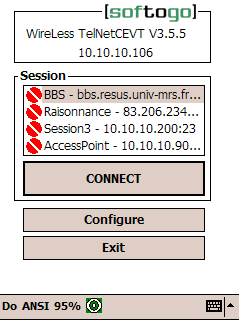
At the top of the screen, the terminal ip address and the WTNCE version are shown.
Click on the session you want to connect and then click the Connect button.
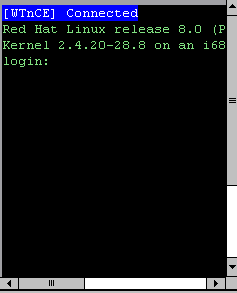
While connecting to the host, wait a few seconds.
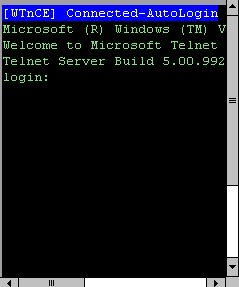
The keyboard is locked while "Auto-Log"
feature is running. Waits for the Log prompt, and the password prompt (and
optionally for user and code). After
successful "sign on" or failure, the keyboard unlocks.
You will manually unlock the keyboard by the unlock
sequence.
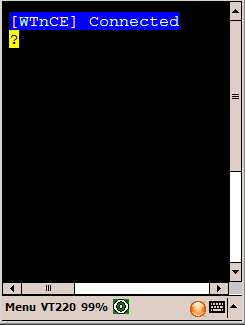
The current terminal type (TERMINAL ) appears in the command bar. See selected by host.
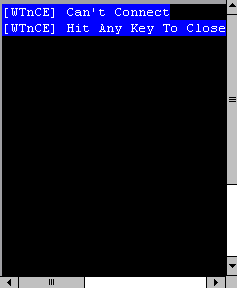
If the connection is not possible, the following screen appears:
While connected in a telnet session, the session will be closed by the host, or by the user. To close the Telnet connection, key the end sequence. (Normally Ctrl-X), and the terminal returns to the Main menu. Or click on Disconnect option in the menu if the command bar is visible (see CHAPTER 6 CommandBar).
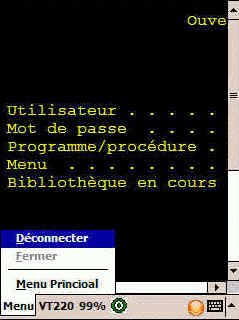
From the Main Menu, click the Configure button to see the configuration. See Chapter 4 for further information.
A printer may be attached to the serial port of the PDA. Special DEC-VTXXX sequences allow to redirect data flow to the printer. Printer driver in WTnVt is designed for "label" printers instead "line" printers, and data is stored in terminal to allow reprint operations.
If printer is not responding, the terminal displays a Pop Up :
|
****** ERROR ****** PRINTER NOT CONNECTED [ENTER] To Retry [CLEAR] To Abort |
Printer state may be checked by host using escape sequences.
The scanner activation is done by the trigger keys, depending on the terminal
model. The scanner is activated and configured
by the [SCANNER]
section in the configuration file. Each barcode symbology
has a specific section in the same file.
Scanner state may be set on or off by host escape sequences (ROI
or Telxon).
PDA Keyboard is "one finger" operating. When a keystroke needs a combination of several keys, those keys should be keyed sequentially (not at same time like PC's Keyboard).
To make a "Function + Control + Up-Arrow" function (e.g. to do a logical scroll up), do the following sequence :
 Key.
Key.The displayed blinking cursor reflects the keyboard state.
PDA Keyboard changes following the terminal. The same terminal may be shipped with different keyboards. The PDA keyboard has the following states :
| Keyboard state | Key Sequence |
|---|---|
| Normal state locked, (toggle with Alpha key). | [ALPHA] key |
| Alpha state (in 35 keys terminals) locked, (toggle with Alpha key). | [ALPHA] key |
| Shift state, single. | [SHIFT] key |
| Control state, single. | [CTRL] key |
| Function state, single. | [FUNC] key) |
| Shift-Function state, single. | [SHIFT]+[FUNC] keys |
Locked, means that the state remains locked, and changes at each time the [ALPHA] key is pressed ("toggle" system).
Single, means that the state applies only for the next keystroke, and then returns to the normal previous state.
WTnVt has predefined function keys that generates escape sequences following the current terminal type. These sequences are configured into the configuration file (Chapter 5) and may be changed. The defined function keys are :
,
 , etc) generates escape
sequences too (see [VT_CURKEYS_XXX] section).
, etc) generates escape
sequences too (see [VT_CURKEYS_XXX] section).
Some function keys, are trapped by the PDA operating system and perform some specific functions like "Lamp" (Backlight), "Dark" (dark LCD display), "Light" (dim LCD display), and may not be used for other functions.
See also Appendix E
"Keyboard Reference".
See also Appendix A "Terminal
Functions".
The emulated terminal normally has a 24 lines and 80 rows screen. WTNVT allows to configure non-standard display sizes emulation, up to 80 rows and 25 lines (See [VT_EMULATION] section).
For easy-to-use applications it is recommended to write or adapt them to the physical display size of the hand held terminal.
WTNVT has a "Logical Scroll" mechanism to allow large screen sizes to be mapped into the smaller PDA display (see [SCROLL] section). The map may be fixed or moving controlled by the FixedMode= option.
It is not recommended to use the moving option in an application, because users need to learn functions keys to scroll, and understand the "Logical Scroll" system.
The "Logical Scroll" system, automatically moves the PDA display into the screen area, following "edges", to show a display area around the cursor position.
User may also move the display area into the screen by using :
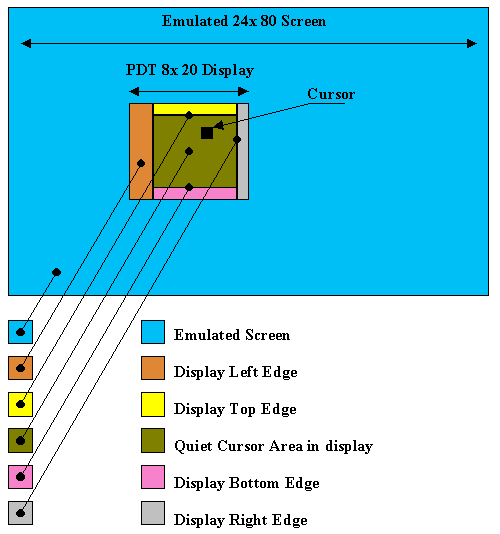
In the fixed mode, the position of the display in the emulated screen is fixed, even if the cursor goes out of the display area.
The RF transmission is a complex program with many protocol layers (RF, Ethernet, IP, TCP) in the operating system and an user application (client). This protocol stack in hand held terminals is subject to unexpected power off conditions (batteries removed, shocks, etc) that may prevent the terminal software to manage correctly some protocol sequences and may "hang" the terminal.
To restart the terminal in proper conditions, it will be necessary to reboot by a warm boot. See Appendix E - Resetting the device.